
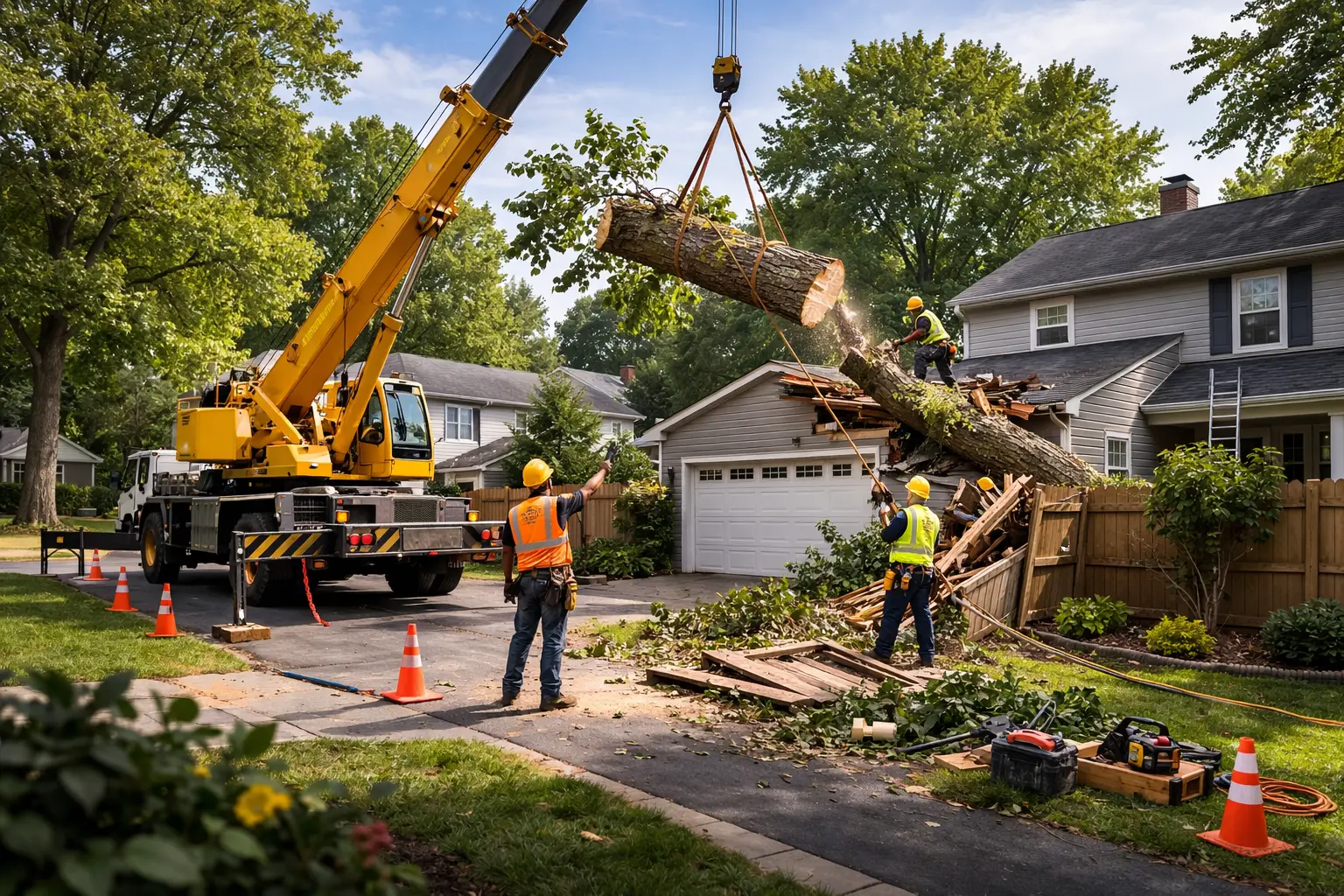
If a tree company tells you your job needs a crane, your first reaction is probably sticker shock. Maybe a little skepticism too. Is that actually necessary, or are they just padding the ticket?
The honest answer: sometimes it’s genuinely the only safe way to do the job. Sometimes it isn’t. Knowing the difference is worth a few minutes of your time.
Why a Crane Enters the Picture at All
Standard tree removal works on the assumption that sections can be dropped or lowered into open space nearby. A climber goes up, cuts in sections from the top down, pieces land in the yard, chipper eats the brush. Clean and predictable.
That method breaks down when there’s nowhere for the pieces to go. A big tree jammed between a house and a fence with utility lines on the other side has zero good drop zones. A crane solves that by lifting sections straight up and swinging them to wherever there’s clear ground.
The other situation where cranes show up: when the tree is in bad enough shape that sending a climber up isn’t safe. Internal decay isn’t always visible. A tree that looks solid can have compromised wood at its core, and a climber putting weight on a branch that fails without warning is a serious problem. From the ground with a crane, nobody’s in the tree when it’s cut.
Storm Damage and Trees on Structures
This is the scenario most homeowners actually run into. A tree comes down in a storm and it’s not sitting in the open yard. It’s on the house, the garage, a parked car. Now what?
Here’s the problem with just cutting it from the bottom up: everything above the cut still has to go somewhere. If there’s a roof under the tree, the pieces don’t have a good place to land. You end up making the structural damage worse than the original impact. A crane holds each section before the cut happens. When the saw goes through, the crane’s already got it. That section gets lowered to clear ground instead of dropped onto whatever’s below.
It’s slower and it takes more coordination, but on a job like that, the control is the whole point. You can find more on crane-assisted tree removal through Tree On Me’s site. For a broader look at what they handle in the area, tree removal services in Montgomery County covers the full picture.
It Takes More Space and More Lead Time
A crane is a big piece of equipment and it needs somewhere to stand. Usually that means a driveway or a section of open yard wide enough to position and stabilize the rig. If the access is limited, that complicates things. The crew may need to clear the area first before the crane can even get set up.
Budget more time for these jobs overall. The planning involved is different from a standard removal, and if the company is coordinating with a crane operator they don’t have on staff, scheduling can take a few extra days.
What to Ask When a Contractor Recommends It
Don’t just take the recommendation at face value. Ask them to walk you through why your specific tree, in your specific yard, can’t come down the standard way. What’s the drop zone problem? Is the canopy compromised? Is it the structure underneath?
A contractor who knows what they’re doing will have a clear answer. If the explanation is vague or they pivot quickly to talking about price, that’s your cue to get a second opinion before committing.
Also find out whether they own the crane or whether they’re subbing it out. Both are workable. You just want to know who’s actually operating the equipment and whether that person does this regularly.
Crane Jobs Cost More. Get the Site Seen First.
There’s no way around the cost question, so let’s be direct: crane removal runs more than standard removal. More equipment, more labor, more coordination. The range is wide because it depends on the tree, the site, and the complexity of the lift.
Anyone who gives you a confident number over the phone without visiting the property is just guessing. Get someone out to look at the actual job before you agree to anything. And if something about the recommendation doesn’t sit right with you, a second opinion is always a reasonable thing to ask for.